

Do Does Clean Ticks Off Their Fawns?

Genkan of a residence in Nippon, viewed from outside looking in.
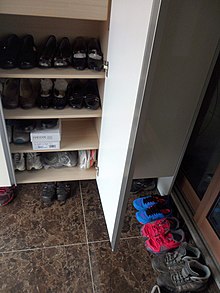
In many cultures at that place is a tradition of removing one's shoes in the habitation and places such as churches, temples and schools.[1]
Backgrounds [edit]
In religions originating in the Indian subcontinent and in the Middle Eastward, it is customary to remove i's shoes when inbound a business firm of worship. In the Bible, God commanded Moses to remove his sandals before budgeted Him on Mount Sinai.[2] The Eastern cultural context of this narrative regards shoes every bit bringing in dust into the habitation and removing one'due south shoes "would be a way of recognizing one's personal uncleanness in the presence of holiness."[2] Hinduism and Islam too regard feet equally being unclean; it is considered sacrilegious to touch books with one's feet and an insult to point one'south anxiety at someone.[3] Equally such, in many mandirs and mosques, as well equally in churches and synagogues of the Indian subcontinent and Middle East, it is customary for worshippers to remove their shoes before entering a house of worship, where they believe they are entering into the presence of the divine.[3]
In the world [edit]
Asia [edit]
Many Asian countries[4] [five] typically follow the tradition of removing shoes before entering a house.[6]
In Pakistan, Transitional islamic state of afghanistan and other countries where having carpeted rugs are common, it is considered necessary to have one'due south shoes off in order to walk on carpeted rugs within the dwelling house.
Western asia [edit]
In Iran, removing one's shoes earlier entering a home is a widespread tradition, with the cleanliness of a home very important for families. It is besides mutual to remove shoes in kindergarten schools and, although rarely, in some small private businesses.
In the Arab world, no shoes are immune indoors, as the shoes' soles are seen as muddied and unsanitary. Arabs are required to remove their shoes when entering a mosque, as are all adherents of Islam.
While it is not mandatory, many Israelis remove their shoes at home. During the Priestly Blessing in the synagogue, the kohanim (priests) volition remove their shoes. Israel is as well home to many Muslims, who harbour much stricter shoe-wearing rules than their Jewish counterparts.
East asia [edit]
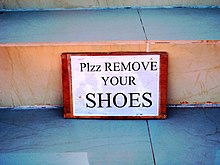
"PLZZ REMOVE YOUR SHOES." Sign at entrance to stupa. Nubra, India
In Japan, the genkan , an entryway area to a house, apartment, or edifice, is where outdoor shoes are removed, and where i changes into uwabaki , indoor slippers. In addition, there are separate toilet slippers ( トイレスリッパ , toire surippa ) into which 1 changes earlier inbound the washroom from the rest of the house. The outdoors are considered to be an extremely unclean space past the Japanese people, alongside the same toilet area. Only the indoors is considered a clean infinite, and it is typically kept very tidy by the homeowner. Ane must alter into appropriate footwear before entering the corresponding spaces. On tatami, information technology is oftentimes considered to be inappropriate to wear even uwabaki .
It is habitual to remove outdoor footwear and put on a pair of slippers after entering the Chinese household, although some people in certain parts of China do not have off their shoes at home.[iv] In social reunions or parties at houses, guests are not ever demanded to take their shoes off, especially in big celebrations such equally the Chinese New year's day, when the number of guests in a house is oftentimes superior to the number of slippers available for guests.
Southeast Asia [edit]
In Malaysia, information technology is common practice (amongst all of the various ethnic communities) to remove their shoes before entering any house or apartment.[7] [8] [ix] More than modernistic households will use and provide indoor slippers. Some temples like Batu Caves and religious places such as mosques and suraus crave the removal of shoes before entering.[7] Mod schools require students to remove their shoes before entering air-conditioned spaces including designated classrooms, laboratories, libraries and carpeted administrative spaces. Students still habiliment shoes at more open spaces such as sports courts, halls, passively ventilated classrooms, passively ventilated laboratories or in the corridors; these areas are more exposed to the elements every bit Malaysian schools are mostly passively ventilated, assuasive natural airflow due to the warm conditions. Some smaller private offices and mixed shopfront-offices do the removal of shoes, especially on (but non limited to) carpeted floors.
In Thailand, all homes crave the removal of shoes and placement of them in forepart of the main door. One too needs to remove their shoes to enter some buildings in Thai temples, especially in Ubosot. Kindergarten schools and some buildings in old unproblematic or high schools also require students to have off their shoes also. However, in some houses or schools, slippers are allowed, but those are not allowed outside the buildings, besides in some restrooms in that location are provided sandals for changing before entering restrooms to keep it clean.
In Vietnam, information technology is customary to remove shoes earlier entering any house or flat. It is as well mutual to remove shoes in kindergarten schools and in some small individual businesses.
Myanmar (Burma) [edit]

In Myanmar, footwear is customarily removed before inbound a home and Buddhist places of worship.[x] Many workplaces in Myanmar likewise take shoe-free areas, or restrict footwear birthday, with shoes typically left at the corridor or at the entrance of an role.[11] [12]
These customs are strictly enforced in Buddhist places of worship, including Burmese pagodas and in Buddhist monasteries chosen kyaung.[thirteen] The Burmese remove their footwear at such sites as a sign of religious respect.[xiv]
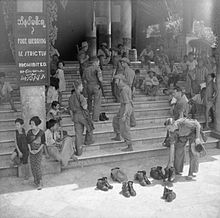
British soldiers remove their shoes at the archway of Shwedagon Pagoda. To the left, a sign reads "Foot wearing is strictly prohibited" in Burmese, English language, Tamil, and Urdu.
Strict enforcement of this custom, even so, is partly a legacy of British dominion in Burma, during which Europeans refused and were exempted from removing their footwear when entering Buddhist places of worship.[15] In pre-colonial Burma, non-royals removed their footwear before entering palace grounds, as a token of respect for the reigning monarch. In the terminal years of the Konbaung dynasty, diplomatic relations between the British and Burmese soured when the British Resident, a colonial representative, refused to remove his shoes upon entering the Mandalay Palace platform, a decision that prevented him from coming together King Thibaw Min.[xvi] Consequently, the British withdrew the Resident and his delegation in October 1879, with his exit portending the Third Anglo-Burmese War, after which the remaining half of the Burmese kingdom (Upper Burma) was fully annexed into British India.[16]
This "shoe question" became a rallying cry for Burmese nationalists, comparable to the cow protection movement in neighboring British Bharat.[15] In 1916, the nationalist Young Men'south Buddhist Association (YMBA) began campaigning against foreigners wearing shoes in pagoda grounds, with Buddhist monks at the forefront of the entrada.[17] [14] The Ledi Sayadaw, a prominent Buddhist monk, penned On the Venial of Wearing Shoes on Pagoda Platforms, which drew in widespread support for the YMBA's activism.[18]
In 1919, after a 2-year battle, Cambridge-educated barrister, Thein Maung, a YMBA fellow member, successfully persuaded the colonial authorities to issue an order prohibiting footwear on the grounds of religious sites.[19] Thein Maung'due south undertaking was in direct response to the actions of Archibald Cochrane, future Governor of Burma, who had kept his shoes on while touring Shwemawdaw Pagoda in Pegu (now Bago) in 1917, much to the indignation of locals.[19]
In recent years, foreigners have been successfully prosecuted and punished for refusing to remove their footwear at Burmese religious sites. In Baronial 2022, a Russian tourist was arrested and sentenced to one month and so a farther six months of jail fourth dimension and hard labor[20] for repeatedly refusing to remove her shoes upon entering pagoda grounds throughout Bagan, as she had violated local customs, per Department xiii(1) of the Immigration Human action.[21] Burmese authorities after announced a crackdown tourists wearing shoes inside Bagan's pagodas.[22]
India [edit]
In Bharat, it is customary for shoes to be taken off whenever entering the dwelling.[23] [24] It is often considered by hosts, every bit rude when guests keep their shoes on whilst inside the house. It is considered sacrilegious to bear upon books with i's feet and an insult to point i'south anxiety at someone.[3]
Australasia [edit]
New Zealand [edit]
Removing shoes earlier inbound a business firm is common-place in New Zealand, in all areas and may stalk from the Māori tradition of removing shoes before entering the Marae.[25]
Europe [edit]
Western Europe [edit]
In the United kingdom, in that location are people in both camps. [26] [27] That said, it is uncommon for people to walk around barefoot with people preferring to go on their socks on.
In France, a rule similar to that of the one in the Britain exists.
In kingdom of the netherlands it is a little uncommon to have off your shoes at home. Visitors are not unremarkably expected to have off their shoes when entering a home. Notwithstanding, in some cases a host may ask people entering the habitation to take off their shoes. Like in the UK, information technology is uncommon to walk around barefoot.
In Republic of ireland, information technology is very uncommon to take ane's shoes off when entering a house, particularly for visitors.
Southern Europe [edit]
In Italy, shoes are customarily removed at the front door upon arrival at home. It is uncommon for Italians to go barefoot in the dwelling, yet, due to concerns over the spread of dust-bourne pathogen. Considering of this, the use of slippers (unremarkably referred to every bit pantofole or ciabatta) in the Italian home has become universal; wool types are worn during the winter and open-toed during the summertime.[28] Nonetheless, this does non apply when entering someone else's home, or when welcoming guests at your own habitation, every bit, in both cases, wearing shoes is usual and as a sign of respect. Furthermore, areas outside the domicile are considered dirty and thus the use of shoes which fully cover the foot are mandated, harrowing dorsum to the stereotype of the overly-tidy Italian mother and her mammoni children.
There is no specific standard on footwear in the Spanish or Portuguese habitation. Information technology is commonplace in both countries to enter the habitation with shoes on. Nonetheless, some people in Spain choose to wearable slippers. In Portugal, it is equally common for people to go barefoot in the home due to the warm weather, cleaner surfaces and proximity to the sea. Generally speaking, the Portuguese and Spaniards usually set their ain rules regarding footwear in their ain homes, while visitors await to be given pedagogy.
In Greece, it is uncommon to go barefoot in the home. When at home it's a personal choice to either habiliment shoes or slippers, nonetheless, the use of slippers (unremarkably referred to as "pantofles") in ane'south own home is commonplace. It is non customary to remove one'due south shoes when visiting another household unless one is asked to do so, and shoes are not removed on any social occasion. Shoes are kept on in churches, likewise as all other public indoor spaces.
In Turkey, near people remove their shoes before entering whatsoever house. Students or employees never remove their shoes before inbound their buildings (schools, workplaces, etc.). The just practice of removing shoes outside the dwelling house is before inbound "inside" the mosque; all the same, people never remove shoes when in a mosque's courtyard or garden.
Eastern Europe [edit]
In all the Slavic countries (Russia, Ukraine, Poland, etc.), most of which are in Eastern Europe, people volition take off their shoes at home and volition look visitors to practice so, unless it is a formal coming together or a social issue. When in doubt, people will normally ask if they can keep their shoes on. When at home, some people will walk barefoot while others will vesture slippers (this often depends on the type of floor covering, eastward.1000. carpets vs wooden floor). It is mutual for schoolchildren to have a special pair of shoes for wearing at schoolhouse, especially in winter. Some people volition accept a special pair of shoes for wearing at work, especially in winter. In restaurants, shops, theatres, and museums shoes are not taken off. Shoes are not taken off in churches.
In the southeast of Europe (quondam Yugoslavia, Albania, Republic of bulgaria, etc.), people traditionally remove their shoes and either walk barefoot or wear indoor slippers at domicile, especially in winter. Visitors that venture beyond the entry hallway are expected to remove their shoes. Because of this, it is considered courteous for hosts to provide slippers for their guests. Some workplaces may require their employees reserve a pair of shoes for indoor utilize. Shoes are kept on in churches, too as nigh other public indoor spaces, just they are always removed in mosques.
Central Europe [edit]
In Primal Europe, the customs in that location regarding the commonality of shoe-wearing in the home and beyond remains by and large identical to that of the Slavs. This holds peculiarly true for the nations of Hungary, Romania, and Moldova. Further, Poland, a Slavic country, is typically included in the definition for Fundamental Europe in opposition to Eastern Europe.
In Slovenia similar in former Yugoslavia, people traditionally remove their shoes and article of clothing indoor slippers at home. For visitors slippers are provided if entering the house.
In Germany and Republic of austria shoes are generally also traditionally removed, but to a less extent, beingness also not uncommon to let them in. This is the case peculiarly for curt visits, even if entering interior rooms.
Northern Europe [edit]
In Northern Europe, Scandinavia information technology is considered unhygienic and rude by nearly to keep one's shoes on when entering a house, in item boots or outdoor walking shoes. In that location may be exceptions, specially when it is a curt visit where information technology is not necessary to enter the interior rooms of the firm or flat. For the near function though, shoes are taken off - in function due to the harsh winter weather condition.
Northward America [edit]
Usa [edit]
Taking shoes off indoors is not a tradition inside the continental United states of america,[29] [30] [31] but is considered expected in Hawaii, Alaska, Guam, and the Northern Mariana Islands. Co-ordinate to a YouGov poll in 2022, whilst many Americans take off their shoes whilst indoors at abode, they may or may not request their guests to accept off their shoes.[32] It is besides prevalent in the Northeast due to poor weather condition in the winter, likewise equally in the Pacific Northwest, with standards differing from household to household. In New England, many elementary schools require students to bring an indoor pair of shoes as well as winter boots. This is especially the case during rainy weather, when one's shoes could easily become very muddied, wet, or dirty. Notwithstanding, removing of shoes is common among certain immigrant communities.
Canada [edit]
In Canada, households often practise not wear shoes in the domicile.[33] [34] [35] [36] [37] In full general it is expected that a guest would remove their shoes on entering a home unless the host states otherwise.
In addition to residential homes, the removal of shoes also occurs in other settings, particularly during the wintertime; as footwear worn outside may be wet from snow and soiled past the associated table salt/sand that is used to clear roads of snow embrace. As a effect, many schools in Canada require students to bring with them or exit behind a pair of "indoor shoes" at the school for indoor wear during the winter months.[38] Similarly in role settings, employees will unremarkably habiliment indoor shoes in the wintertime. However outdoor shoes are worn in part settings in the summer. Some specialized medical facilities require patients to remove shoes in lodge to maintain cleanliness.
Come across also [edit]
- Hygiene in Christianity
- Listing of shoe-throwing incidents
- Shoe tossing
References [edit]
- ^ Spier, Ally (2020-04-24). "Should You lot Have Your Shoes Off While Indoors?". Architectural Digest . Retrieved 2021-02-01 .
{{cite web}}: CS1 maint: url-status (link) - ^ a b Lioy, Daniel (2008). KJV International Bible Lesson Commentary: The New Standard in Biblical Exposition Based on the International Lord's day School Lessons (ISSL). David C. Cook. p. 321. ISBN978-1-4347-9975-3.
- ^ a b c DeMello, Margo (2009). Feet and Footwear: A Cultural Encyclopedia. ABC-CLIO. p. 34. ISBN978-0-313-35715-2.
- ^ a b "Shoes on or off inside? The Chinese haven't always been in agreement, especially when at that place are chairs involved". South Cathay Morn Post.
- ^ "The Chinese didn't always accept their shoes off at home". Inkstone. 2022-03-01. Retrieved 2021-02-01 .
{{cite web}}: CS1 maint: url-status (link) - ^ "Why homes in Asia maintain a strict shoes-off dominion". South China Morn Post. 2022-12-13. Retrieved 2021-02-01 .
- ^ a b Hays, Jeffrey. "CUSTOMS, MANNERS AND ETIQUETTE IN MALAYSIA | Facts and Details". factsanddetails.com . Retrieved 2021-02-01 .
- ^ "Malaysian Civilisation - Etiquette". Cultural Atlas . Retrieved 2021-02-01 .
- ^ Liew, Jessica (2018-02-13). "What's An Embarrassing CNY Mode Faux Pas? These 3 Power Dressers Tell All". Tatler Malaysia . Retrieved 2021-02-01 .
- ^ "Culture and etiquette in Myanmar (Burma) | Local customs in Myanmar (Burma)". Rough Guides . Retrieved 2020-12-12 .
- ^ "Etiquette Counselor: Tips for doing business concern in Myanmar". Discovery. 2022-eleven-16. Retrieved 2020-12-12 .
- ^ "MYANMAR Concern ETIQUETTE: THE DOS AND DON'TS OF MEETINGS IN BURMA". MVA. 2022-06-21. Retrieved 2020-12-12 .
- ^ Gilberti, Christian (2019-05-20). "The "Shoe Question" in Colonial Burma". MYANMORE . Retrieved 2020-12-12 .
- ^ a b Larkin, Emma (2003). "The Self-Conscious Censor: Censorship in Burma under the British, 1900-1939". Journal of Burma Studies. 8 (i): 64–101. doi:ten.1353/jbs.2003.0002. ISSN 2010-314X.
- ^ a b Cheesman, Nick (2017-05-27). "Introduction: Interpreting Communal Violence in Myanmar". Journal of Gimmicky Asia. 47 (3): 335–352. doi:10.1080/00472336.2017.1305121. ISSN 0047-2336.
- ^ a b Shah, Sudha (2012-06-14). The King In Exile : The Autumn Of The Majestic Family Of Burma. Harper Collins. ISBN978-93-5029-598-four.
- ^ Wong-Anan, Nopporn (2007-09-28). "Buddhist monks no strangers to Myanmar politics". Reuters . Retrieved 2020-12-12 .
- ^ "British Burma - The Emergence of Political Movements". GlobalSecurity.org . Retrieved 2020-12-12 .
- ^ a b "On This Twenty-four hours | 'Shoe Thein Maung' Fought to Stop Colonists Trampling on Buddhist Customs". The Irrawaddy. 2022-03-11. Retrieved 2020-12-12 .
- ^ "Russian woman sentenced to 6 months jail, hard labour". The Myanmar Times. 2022-08-30. Retrieved 2020-12-12 .
- ^ "Russian tourist sentenced to another vi months in jail for wearing shoes most pagodas". Coconuts Yangon. 2022-08-30. Retrieved 2020-12-12 .
- ^ "Crackdown on Shoe-Wearing in Myanmar Pagodas". TravelPulse . Retrieved 2020-12-12 .
- ^ Putinja, Isabel (2017-10-xx). "Things Y'all Should Never Do in India". Oyster.com . Retrieved 2021-02-01 .
- ^ "Science Confirms What Indians Always Do: Go out Shoes Outside Domicile, Every bit They Tin can Brand You Sick". IndiaTimes. 2022-07-21. Retrieved 2021-02-01 .
- ^ "Shoes at the door of the wharenui". Te Ara - The Encyclopaedia of New Zealand. v September 2022. Retrieved half dozen May 2022.
- ^ "Should you have your shoes off inside the firm?". the Guardian. 2022-04-10. Retrieved 2021-02-01 .
- ^ "Wearing your shoes indoors is i of the grossest things y'all could do". Metro. 2022-08-06. Retrieved 2021-02-01 .
- ^ "Italian Life Rules – If The Shoe Fits". Tuscan Traveler . Retrieved 2021-01-xiii .
- ^ "Why practise Americans habiliment shoes in the business firm and Asian Don't?". Summit Pick Footwear. 2022-eleven-xviii. Retrieved 2021-02-01 .
- ^ "Shoes: On Or Off Inside? Why This American In Singapore Struggles With A Mutual Asian Practice – Past Expat Andrea McKenna Brankin". The Finder. 2022-06-07. Retrieved 2021-02-01 .
- ^ Heidenry, Margaret (2018-xi-21). "I think information technology's rude to ask guests to have off their shoes-Here's why". Chron . Retrieved 2021-02-01 .
- ^ "Nearly Americans take their shoes off at home, simply don't await their guests to | YouGov". today.yougov.com . Retrieved 2021-02-01 .
- ^ "Living in Canada? Take your shoes off. | Living Abroad in Canada". 2022-01-06. Retrieved 2021-02-01 .
- ^ Logan, Hannah (2017-06-02). ""Have Your Shoes Off" Is Not a Suggestion in My House". Proficient Housekeeping . Retrieved 2021-02-01 .
- ^ "They Take Their Shoes Off Indoors – How to Spot a Canadian". Retrieved 2021-02-01 .
- ^ "Shoes off or on in the firm? | Toronto". Yelp . Retrieved 2021-02-01 .
- ^ "Is shoe removal a Canadian civilisation affair?". Houzz . Retrieved 2021-02-01 .
- ^ "Dress Code". Renfrew ounty Commune School Lath. 2022. Retrieved 26 February 2022.
- Lo scarpisfero
- Living in Canada? Take your shoes off.
- Jews and Shoes
- Arab civilization: the insult of the shoe

Source: https://en.wikipedia.org/wiki/Tradition_of_removing_shoes_in_the_home_and_houses_of_worship
Posted by: duartedenjudd67.blogspot.com
0 Response to "Do Does Clean Ticks Off Their Fawns?"
Post a Comment